|
Feb. 11 Mira-type MisV1258 is bright.
It is 12.2 mag(Rc) in January, brightest in its history, from Tsutomu Fujiwara's observations.
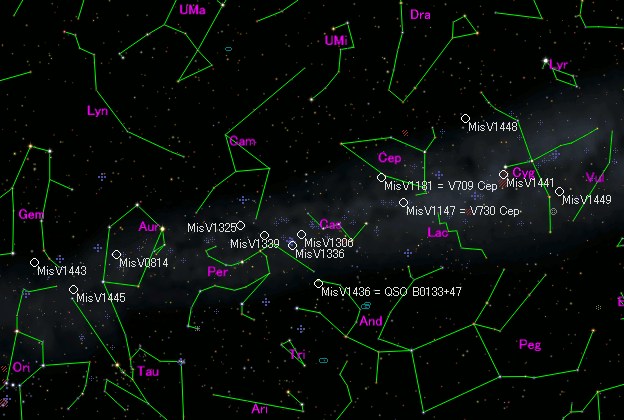
Jan. 27 Optically violently variable quasar MisV1436 is brightening.
Miguel Rodriguez Marco and Diego Rodriguez reported that it is brightening up to 16 mag in late January.
Jan. 27 Pre-discovery image of AW Gem's outburst
Outburst of AW Gem was discovered by Gary Poyner on Nov. 18, 2012.
We found that AW Gem was already bright at 13.8 mag on Nov. 14 from Youichirou Nakashima's images.
Jan. 3 Herbig Ae/Be type star MisV1325 is brightening.
Herbig Ae/Be type star MisV1325 is brightening after about 2 year faint period since early 2011 from Tsutomu Fujiwara's observations.
Dec. 31 Optically violently variable quasar MisV1436 is brightening.
Diego Rodriguez reported that it brightened up to 16.3 mag on Dec. 23.
It became around 16.5 mag for the first time since 2009.
Oct. 13 Outburst of a dwarf nova PS Lac was detected.
Outburst was detected at 15.4 mag on Oct. 7 from Youichirou Nakashima's survey images.
Oct. 13 Outburst of a dwarf nova V767 Cyg was detected.
Outburst was detected at 15.9 mag on Oct. 7 from Youichirou Nakashima's survey images.
We have also detected the outburst on July 18.
So maybe this star tends to be in outburst frequently.
Oct. 6 Outburst of a dwarf nova KT Gem was detected.
Outburst was detected at 16.1 mag on Sept. 26 from Youichirou Nakashima's survey images.
Sept. 30 Outburst of a dwarf nova HV Aur was detected.
Outburst was detected at 16.3 mag on Sept. 25 from Youichirou Nakashima's survey images.
Sept. 30 Outburst of a dwarf nova SDSS J032015.296+441059.3 was detected.
Outburst was detected at 16.4 mag on Sept. 11 from Youichirou Nakashima's survey images.
Sept. 2 Type and period of MisV0796 and MisV0871 were revealed.
Klaus Bernhard and Stefan Huemmerich revealed MisV0796 and MisV0871 are Mira type variables with a period of 298 and 255 days.
Sept. 1 Type and period of MisV1334 and MisV1335 were revealed.
Taichi Kato revealed MisV1334 and MisV1335 are RR Lyr-type (RRAB type) variables.
Aug. 6 Outburst of a dwarf nova V584 Lyr was detected.
Outburst of a dwarf nova V584 Lyr was detected at 15.8 mag on Aug. 2 from Youichirou Nakashima's survey images.
Aug. 4 Another outburst of a dwarf nova V792 Cyg was detected.
Another outburst of a dwarf nova V792 Cyg was detected at 14.9 mag on Aug. 2 from Youichirou Nakashima's survey images.
We have detected the outbursts of this star also on Mar. 25 and May 27.
Aug. 3 Outburst of a dwarf nova V1113 Cyg was detected.
Outburst of a dwarf nova V1113 Cyg was detected at 14.3 mag on July 30 from Youichirou Nakashima's survey images.
July 29 Dwarf nova V405 Vul brightens in outburst frequently.
Another outburst was detected on July 27.66 (UT) from survey images by Youichirou Nakashima.
V405 Vul tends to brighten in outburst frequently, maybe with an interval of about 2 months.
July 29 Outburst of a dwarf nova V868 Cyg was detected.
Outburst of a dwarf nova V868 Cyg was detected at 15.2 mag on July 26 from Youichirou Nakashima's survey images.
July 23 Outbursts of several dwarf novae were detected.
Outbursts of dwarf novae OT J170609.7+143452, V542 Cyg, V767 Cyg, V1006 Cyg were detected from Youichirou Nakashima and Nobuo Ohkura's survey images on July 17 and 18.
June 8 New bright dwarf nova, 12 mag at brightest, was discovered.
We discovered a new dwarf nova at 13.4 mag from Youichirou Nakashima's survey images on May 27.
Denis Denisenko found the pre-discovery data by the MASTER robotic telescopes at 12 mag on May 13.
June 5 Another outburst of a dwarf nova V792 Cyg was detected.
Another outburst of a dwarf nova V792 Cyg was detected at 14.4-14.7 mag on May 27 from Youichirou Nakashima's survey images.
The last outburst was on Mar. 25.
May 15 Outburst of a dwarf nova V1047 Aql was detected.
Dwarf nova V1047 Aql was detected at around 15.5 mag on May 12.68 (UT) from survey images by Youichirou Nakashima.
May 15 Another outburst of a dwarf nova V405 Vul was detected.
Another outburst was detected on May 11.68 (UT) from survey images by Youichirou Nakashima.
The last outburst was detected on Mar. 13. So maybe V405 Vul tends to brighten in outburst frequently.
May 15 Outburst of a dwarf nova V1008 Her.
Mike Simonsen discovered the outburst at 13.3 mag on May 11.2910.
We found that it was already bright at 13.9 mag on May 10.55 from survey images by Youichirou Nakashima.
Apr. 21 Outburst of a dwarf nova V725 Aql is superoutburst.
The present outburst of a dwarf nova V725 Aql, discovered by the MISAO Project, is superoutburst.
Apr. 18 Outburst of a dwarf nova V725 Aql was detected.
Outburst of a dwarf nova V725 Aql was detected from survey images by Youichirou Nakashima, at around 14.0 mag on Apr. 16.73 (UT).
Apr. 18 Small outburst of a nova-like star V426 Oph was detected.
Small outburst was detected on Apr. 16 from survey images by Youichirou Nakashima up to 11.8 mag, though it was around 12.4 mag in March.
Apr. 3 Outburst of a dwarf nova RY Ser was detected.
Outburst of a dwarf nova RY Ser was detected at 13.6-13.9 mag on Mar. 31 from survey images by Youichirou Nakashima.
Mar. 31 Outburst of a dwarf nova V792 Cyg was detected.
Dwarf nova V792 Cyg is bright at around 15 mag from Youichirou Nakashima's survey images on Mar. 25.
Mar. 25 Type and period of MisV1429 was revealed.
Stefan Huemmerich and Klaus Bernhard reported the LINEAR and Catalina Sky Survey data revealed it is an Algol-type eclipsing variable with a chromospheric activity (EA/RS type), with a period of 0.4629 days, brightness range of 14.35-14.90 mag(CV).
It exhibits a long term mean magnitude change, probably caused by a long period spot cycle.
Mar. 25 Outburst of a dwarf nova GZ Cnc was detected.
Outburst of a dwarf nova GZ Cnc was detected from survey images by Nobuo Ohkura at about 13.9 mag on Mar. 24.
It rebrightened within only 1 week after the last outburst on Mar. 17.
Mar. 21 Possible unexpected color change of MisV0814.
Possible unexpected color change of MisV0814 was observed by Tsutomu Fujiwara.
The V-Rc value is usually around 0.3-0.4 mag, but it reduced down to +/- 0.0 mag on Mar. 14 and 19.
However, the color has returned to the original value on Mar. 20.
Mar. 20 Type and period of MisV1426 was revealed.
Stefan Huemmerich reported the Catalina Sky Survey data revealed it is an Algol-type (EA) eclipsing variable with a period of 0.57889 days, brightness range of 15.20-15.90 mag(CV).
Mar. 18 Pre-discovery image of a new cataclysmic variable.
New cataclysmic variable OT J094854.0+014911 = CSS120315:094854+014911, discovered by the Catalina Sky Survey on Mar. 15, was already bright at 14-15 mag on Mar. 11 from survey images by Nobuo Ohkura.
Mar. 18 Outburst of a dwarf nova V405 Vul was detected.
Outburst of a dwarf nova V405 Vul was detected from survey images by Youichirou Nakashima at about 15 mag on Mar. 13.
Mar. 18 Outburst of a dwarf nova V1504 Cyg was detected.
Outburst of a dwarf nova V1504 Cyg was detected from survey images by Youichirou Nakashima at 13.9-14.2 mag on Mar. 11.
Mar. 12 Type and period of MisV1427 was revealed.
Stefan Huemmerich, Klaus Bernhard and Sebastian Otero reported the Catalina Sky Survey data revealed it is an Algol-type (EA) eclipsing variable with a period of 0.393231 days, brightness range of 15.45-16.20 mag(V).
Mar. 12 Periods of 5 Mira variables were revealed.
Stefan Huemmerich and Klaus Bernhard revealed the periods of 5 Mira type variables,
MisV0078, MisV0348, MisV0490, MisV0542, MisV0557,
using the MACHO project data
Mar. 4 Paper on dwarf nova MisV1443 is published.
Paper on dwarf novae by Taichi Kato, et al., is published.
MisV1443 is described in this paper.
Mar. 2 Brightening of optically violently variable quasar MisV1436 has ended.
After it brightened up to 18 mag on Jan. 25, it turned to fade down to 18.5 mag on Feb. 20 by Diego Rodriguez's observations.
Mar. 2 Outburst of NSV 02026 was detected.
Outburst of a possible dwarf nova NSV 02026 was detected in the course of Senoh Survey by Nobuo Ohkura.
It was 14.0 mag on Feb. 26.
Feb. 11 Short term variation of MisV1339 by Atsushi Miyashita.
Light curves of time series photometry by Atsushi Miyashita are published.
Short term variation was detected on Feb. 1, 2008.
Feb. 11 MisV1325 is a Herbig Ae/Be type star.
Taichi Kato identified it with an emission-line star IPHAS J034712.63+571132.6. It was revealed to be a Herbig Ae/Be type star based on its color.
Light curve is published.
Feb. 11 Type and period of MisV1435 was revealed.
Stefan Huemmerich reported the Catalina Sky Survey data revealed it is a W UMa-type (EW) eclipsing variable with a period of 0.32119 days, brightness range of 14.7-15.6 mag(V).
Feb. 3 Summary of our new dwarf nova MisV1446 discovery.
We summarized our discovery information of a new dwarf nova MisV1446 on Jan. 9, 2012.
Feb. 3 MisV1447 was already known variable.
Patrick Wils and John Greaves pointed out that the variation of this star has been already known from the NSVS data.
Feb. 1 Brightening start of optically violently variable quasar MisV1436.
After it became faintest in its history, 19.5 mag, on Jan. 11, it brightened up to 18 mag on Jan. 25 by Diego Rodriguez's observations.
Jan. 26 New variable star discovered by Masaru Mukai.
Masaru Mukai, Kagoshima, Japan, discovered a new variable star MisV1447.
This is his first new object discovery.
It will be a Mira type.
Jan. 24 Light curve of MisV1355.
Light curve of a semi regular variable MisV1355 is published by Tsutomu Fujiwara, Diego Rodriguez and Youichirou Nakashima's observations.
Jan. 24 Light curves of 4 long periodic variables.
Light curves of 4 long periodic variables by Diego Rodriguez, MisV1026, MisV1117, MisV1160 and MisV1310, are published.
The periods are not determined yet.
Jan. 23 Light curves of 3 long periodic variables.
Light curves of 3 long periodic variables by Tsutomu Fujiwara, MisV0367, MisV0374 and MisV0797, are published.
The periods are not determined yet.
Jan. 23 New observations of dwarf nova MisV1446.
Diego Rodriguez reported it faded down to 17.5 mag on Jan. 17.
Jan. 9 New observations of optically violently variable quasar MisV1436.
It is 19.1-19.3 mag now, faintest in its history, by Diego Rodriguez and Adolfo San Segundo.
Jan. 9 Re-brightening of dwarf nova MisV1443
Adolfo San Segundo reported it faded down to 20.12 mag on Nov. 25, then it is re-brightening up to 17.66 mag on Jan. 3.
Jan. 9 Outburst of an X-ray source.
We discovered a bright new object of 14.1 mag from Youichirou Nakashima's survey images on 2012 Jan. 5.
It will be an outburst of an X-ray source 1RXS J074112.2-094529.
Jan. 9 Possible real-time flare detection of a new flare star.
We discovered a rapid-brightening star from the survey images taken by Youichirou Nakashima On Dec. 17.
It brightened rapidly by 2 mag or more, from fainter than 16.8 mag up to 14.7 mag, withiin only 4 minutes.
It is possible real-time flare detection of a new flare star.
It has already faded down to 18 mag.
Dec. 27 New observations of T Tau type variable MisV1441.
After the maximum of 14.66 mag on Oct. 28, it turned to be fading and faded down to 16.6 mag on Dec. 16.
Then it was 15.82 mag on Dec. 18, so maybe re-brightening.
Dec. 11 Outburst of a dwarf nova FN And was detected.
Outburst of a dwarf nova FN And was detected in the course of Oku Survey by Youichirou Nakashima on the first survey images of a new 300-mm camera lens.
It was 13.5 mag on Dec. 5, 14.1 mag on Dec. 9.
Nov. 22 Details of New Mira Type Variable MisV1444's Discovery.
Here summarized the details of new Mira type variable MisV1444's discovery.
Nov. 20 Short term variation of T Tau type variable MisV1441.
Short term variation was detected by time series photometry by Hidehiko Akazawa on Nov. 16, 2011.
Nov. 12 T Tau type variable MisV1441 is brightening rapidly.
T Tau type variable, a young stellar object with an H-alpha emission, MisV1441 is brightening rapidly.
It brightened up to 14.66 mag, approaching to the brightest record ever.
Nov. 12 Light curve of optically violently variable quasar MisV1436.
Light curve of optically violently variable quasar MisV1436 is updated.
During the season between 2010 and 2011, it recorded the faintest magnitude of 19.18 mag in its history, then it recovered up to around 16.5 mag.
It keeps fading for the long term from 2007 to 2011.
Nov. 12 Mira variable MisV0218 is brightening.
Diego Rodriguez and Adolfo San Segundo observed the brightening of a Mira variable MisV0218, which well fits to the period of 380 days.
Nov. 12 Light curve of MisV1348.
Light curve of a Cepheid variable MisV1348 is published by Tsutomu Fujiwara's observations.
Nov. 6 Summary of our new dwarf nova MisV1443 discovery.
We summarized our discovery information of a new dwarf nova MisV1443 on Jan. 10, 2011.
Oct. 23 MisV1357 is a Mira-type variable.
Tsutomu Fujiwara's observations revealed that MisV1357 is a Mira-type variable with a range of 4.2 mag.
The period is not determined yet.
Oct. 23 MisV1273 is a semi regular variable.
Tsutomu Fujiwara's observations revealed that MisV1273 is a semi regular variable with a range of 1.9 mag.
The period may be about 140 days.
Oct. 23 MisV1141 is a Mira-type variable.
Tsutomu Fujiwara's observations and the MISAO Project surveys revealed that MisV1141 is a Mira-type variable with a period of 318 days.
Oct. 23 MisV0813 is a Mira-type variable.
Tsutomu Fujiwara's observations revealed that MisV0813 is a Mira-type variable with a range of 4.5 mag.
The period is not determined yet.
|