Weekly Information about Bright Comets (2025 Dec. 6: North)
|
Japanese version Home page |
Updated on December 5, 2025 |
|||
|
||||
|
Best time and the azimuth, altitude (A,h) are at lat. 35 deg in the Northern Hemisphere. Azimuth indicates 0 for south, 90 for west, 180 for north, 270 for east. |

|
|
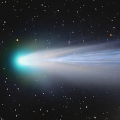
It brightened up to 3.7 mag in late October (Oct. 26, Juan Jose Gonzalez). Fading rapidly. Now it is not observable. It will appear soon in the Southern Hemisphere. Date(TT) R.A. (2000) Decl. Delta r Elong. m1 Best Time(A, h) Dec. 6 17 12.63 -29 44.6 1.773 0.814 8 8.4 18:18 ( 65,-18) Dec. 13 17 12.48 -32 38.2 1.884 0.928 9 9.4 5:28 (296,-21) |
 24P/Schaumasse
|
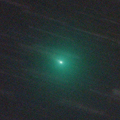
It will brighten up to 8 mag in winter, and will be observable in good condition. Now it is 11.5 mag (Nov. 29, Marco Goiato). It brightens up to 8 mag, but it will turn to fade out rapidly after that. In the Northern Hemisphere, it stays observable in good condition. Date(TT) R.A. (2000) Decl. Delta r Elong. m1 Best Time(A, h) Dec. 6 10 42.99 18 47.2 0.658 1.263 98 9.7 5:23 (343, 73) Dec. 13 11 18.10 17 51.8 0.628 1.234 97 9.1 5:28 (342, 72) |
210P/Christensen
|
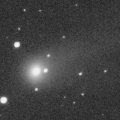
Now it is 9.5 mag (Nov. 28, Michael Jager, Gerald Rhemann, E. Prosperi). Fading rapidly. It will be fainter than 18 mag in March. It will be getting higher gradually. Date(TT) R.A. (2000) Decl. Delta r Elong. m1 Best Time(A, h) Dec. 6 14 23.20 -10 2.7 0.740 0.596 37 9.9 5:23 (296, 17) Dec. 13 14 32.95 -8 54.5 0.852 0.676 42 10.9 5:28 (300, 22) |
C/2025 T1 ( ATLAS )
|
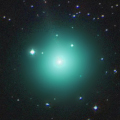
Now it is 9.4 mag (Nov. 26, Osamu Miyazaki). It will fade out rapidly after this. In the Northern Hemisphere, it will be getting lower gradually after this, and it will be unobservable in January. In the Southern Hemisphere, it is not observable now, but it will appear in March. Date(TT) R.A. (2000) Decl. Delta r Elong. m1 Best Time(A, h) Dec. 6 19 31.93 18 16.8 1.281 1.110 56 9.9 18:18 ( 86, 37) Dec. 13 19 55.22 11 25.6 1.433 1.122 51 10.3 18:19 ( 80, 33) |
C/2024 E1 ( Wierzchos )
|
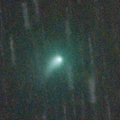
It was originally expected to brighten up to 5 mag in January. But actually, the brightness evolution is slower than originally expected. It will be 8 mag at best. Now it is 10.7 mag (Dec. 3, Mike Olason). Brightening gradually. Now it is not observable. It will appear in January in the Southern Hemisphere, or in February in the Northern Hemisphere. Date(TT) R.A. (2000) Decl. Delta r Elong. m1 Best Time(A, h) Dec. 6 17 50.69 -9 54.1 1.999 1.118 19 10.9 18:18 ( 77, 1) Dec. 13 18 7.20 -13 56.7 1.928 1.005 14 10.4 18:19 ( 75, -4) |
3I/2025 N1 ( ATLAS )
|
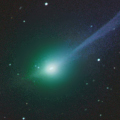
Third interstellar object in history following 1I/'Oumuamua and 2I/Borisov. The eccentricity is extremely big as 6. It approached to Sun down to 1.38 a.u. in late October. Now it is 10.0 mag (Dec. 3, Virgilio Gonano). Fading rapidly. It will be fainter than 18 mag in February. In the Northern Hemisphere, it stays observable in good condition. In the Southern Hemisphere, it will be getting higher gradually. Date(TT) R.A. (2000) Decl. Delta r Elong. m1 Best Time(A, h) Dec. 6 11 43.17 2 6.9 1.862 1.924 78 11.3 5:23 (326, 52) Dec. 13 11 14.31 4 40.1 1.813 2.111 93 11.9 5:28 (350, 59) |
C/2025 K1 ( ATLAS )

|
Now it is 10.6 mag (Nov. 28, Osamu Miyazaki). Fading rapidly. It will be fainter than 18 mag in February. In the Northern Hemisphere, it stays observable in good condition. In the Southern Hemisphere, it is not observable now, but it will be observable soon. The nucleus is split into three components. Date(TT) R.A. (2000) Decl. Delta r Elong. m1 Best Time(A, h) Dec. 6 2 6.21 64 15.6 0.545 1.401 130 11.8 20:59 (180, 62) Dec. 13 1 16.92 52 20.3 0.723 1.525 125 12.8 19:47 (180, 73) |
C/2025 R2 ( SWAN )
|
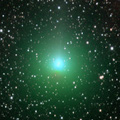
It brightened up to 5.2 mag in October (Oct. 11, Virgilio Gonano). Now it is 11.3 mag (Nov. 28, Osamu Miyazaki). Fading rapidly. It will be fainter than 18 mag in March. In the Northern Hemisphere, it stays observable in good condition. In the Southern Hemisphere, it will be getting lower gradually. Date(TT) R.A. (2000) Decl. Delta r Elong. m1 Best Time(A, h) Dec. 6 0 17.20 8 48.8 1.094 1.740 113 12.1 19:17 ( 0, 64) Dec. 13 0 30.11 9 44.3 1.265 1.847 109 12.7 19:02 ( 0, 65) |
240P/NEAT
|
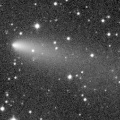
Now it is 11.9 mag (Nov. 29, Marco Goiato). Fading gradually. In the Northern Hemisphere, it stays observable in good condition. In the Southern Hemisphere, it will be getting lower gradually. The component B is brightening rapidly. Now it is bright as 14.8 mag (Nov. 15, Andrew Pearce). Date(TT) R.A. (2000) Decl. Delta r Elong. m1 Best Time(A, h) Dec. 6 3 33.51 9 24.2 1.180 2.125 157 12.1 22:32 ( 0, 65) Dec. 13 3 27.49 11 11.6 1.209 2.122 150 12.2 21:58 ( 0, 66) |
88P/Howell

|
It will brighten rapidly after this. In the Northern Hemisphere, it will be unobservable soon. In the Southern Hemisphere, it is not observable now, but it will appear in January. Date(TT) R.A. (2000) Decl. Delta r Elong. m1 Best Time(A, h) Dec. 6 15 33.71 -18 37.2 2.650 1.741 18 13.1 5:23 (292, -1) Dec. 13 15 53.71 -19 52.3 2.587 1.699 20 12.8 5:28 (295, 0) |
235P/LINEAR
|
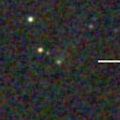
It became brighter than expected. Now it is 13.5 mag (Nov. 29, Ken-ichi Kadota). It stays 13 mag for a while. It locates somewhat low in the Northern Hemisphere. But it will become high in spring. In the Southern Hemisphere, it will be getting higher gradually. Date(TT) R.A. (2000) Decl. Delta r Elong. m1 Best Time(A, h) Dec. 6 13 36.70 -12 10.9 2.520 1.983 46 13.4 5:23 (307, 24) Dec. 13 13 52.60 -13 17.3 2.463 1.980 50 13.3 5:28 (311, 26) |
C/2022 N2 ( PanSTARRS )

|
Now it is 12.8 mag (Nov. 28, Osamu Miyazaki). Fading slowly. In the Northern Hemisphere, it stays observable in good condition. It locates somewhat low in the Southern Hemisphere. Date(TT) R.A. (2000) Decl. Delta r Elong. m1 Best Time(A, h) Dec. 6 3 15.56 25 27.7 3.053 3.985 158 13.4 22:14 ( 0, 81) Dec. 13 3 13.64 25 12.5 3.112 4.003 151 13.5 21:45 ( 0, 80) |
29P/Schwassmann-Wachmann 1
|
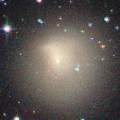
It brightened in outburst up to 13.9 mag on Dec. 5 (Jean-Francois Soulier). It stays observable in good condition. Date(TT) R.A. (2000) Decl. Delta r Elong. m1 Best Time(A, h) Dec. 6 11 30.19 -2 14.3 6.404 6.304 79 14.0 5:23 (333, 49) Dec. 13 11 31.94 -2 35.4 6.291 6.304 86 14.0 5:28 (345, 51) |
C/2022 QE78 ( ATLAS )
|
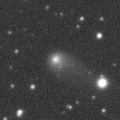
Now it is 14.4 mag (Nov. 29, Purple Mountain Observatory, XuYi Station). It stays 14 mag for a while. In the Northern Hemisphere, it stays observable in good condition. It locates somewhat low in the Southern Hemisphere. Date(TT) R.A. (2000) Decl. Delta r Elong. m1 Best Time(A, h) Dec. 6 9 26.40 21 51.5 5.001 5.512 116 14.4 4:28 ( 0, 77) Dec. 13 9 27.01 22 28.0 4.913 5.518 123 14.4 4:01 ( 0, 77) |
C/2021 G2 ( ATLAS )

|
Now it is 14.4 mag (Oct. 11, Hiroshi Abe). It stays 15 mag for a while. In the Northern Hemisphere, it will be unobservable soon. But it will be observable again in December. In the Southern Hemisphere, it is not observable now, but it will appear in January. Date(TT) R.A. (2000) Decl. Delta r Elong. m1 Best Time(A, h) Dec. 6 16 29.57 -0 49.9 6.949 6.048 22 14.7 5:23 (270, -2) Dec. 13 16 35.22 -0 37.1 6.955 6.077 25 14.8 5:28 (273, 4) |
C/2024 J3 ( ATLAS )
|
It will brighten up to 13 mag in 2026. Now it is 14.9 mag (Nov. 17, Alfons Diepvens). It stays 14 mag for a while. In the Northern Hemisphere, it will be unobservable soon. But it will be observable again in January. In the Southern Hemisphere, it is not observable now, but it will appear in February. Date(TT) R.A. (2000) Decl. Delta r Elong. m1 Best Time(A, h) Dec. 6 18 56.69 -6 50.5 5.694 4.912 34 14.9 18:18 ( 70, 16) Dec. 13 19 1.34 -6 13.5 5.708 4.877 29 14.9 18:19 ( 74, 11) |
C/2025 L1 ( ATLAS )
|
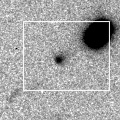
It is expected to brighten up to 13.5 mag and to be observable in good condition in 2026 spring. Brightening slowly. In the Northern Hemisphere, it is not observable now, but it will be observable soon. In the Southern Hemisphere, it will be getting higher gradually. Date(TT) R.A. (2000) Decl. Delta r Elong. m1 Best Time(A, h) Dec. 6 15 17.53 -44 5.4 2.551 1.752 28 15.0 5:23 (315,-14) Dec. 13 15 25.89 -42 23.4 2.502 1.728 30 14.9 5:28 (316, -9) |
C/2024 T5 ( ATLAS )
|
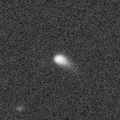
Now it is 14.8 mag (Dec. 1, ATLAS Chile). It stays 15 mag for a while. In the Northern Hemisphere, it will be unobservable in March. In the Southern Hemisphere, it stays observable in good condition. It is expected to brighten up to 11 mag in winter between 2026 and 2027. Date(TT) R.A. (2000) Decl. Delta r Elong. m1 Best Time(A, h) Dec. 6 2 44.54 -44 26.3 5.429 5.798 107 14.9 21:43 ( 0, 11) Dec. 13 2 41.41 -43 40.5 5.441 5.757 103 14.9 21:12 ( 0, 11) |
C/2014 UN271 ( Bernardinelli-Bernstein )
|
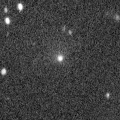
Very large comet. It is expected to brighten up to 13 mag in 2031. Now it is 14.3 mag (Nov. 22, Thomas Lehmann). It stays 15 mag for a while. In the Northern Hemisphere, it is not observable now. In the Southern Hemisphere, it stays observable in good condition. In the Northern Hemisphere, it is not observable until 2030. Date(TT) R.A. (2000) Decl. Delta r Elong. m1 Best Time(A, h) Dec. 6 5 18.01 -74 53.2 14.575 14.481 82 14.9 0:18 ( 0,-20) Dec. 13 5 12.87 -74 57.5 14.564 14.458 81 14.9 23:41 ( 0,-20) |
78P/Gehrels 2

|
It will brighten up to 12 mag in 2026 summer. Now it is 16.3 mag (Dec. 2, ATLAS-HKO, Haleakala). Brightening slowly. It will be unobservable in January in the Southern Hemisphere, or in February in the Northern Hemisphere. Date(TT) R.A. (2000) Decl. Delta r Elong. m1 Best Time(A, h) Dec. 6 20 55.95 -12 28.2 2.910 2.550 59 15.3 18:18 ( 42, 32) Dec. 13 21 6.51 -11 56.2 2.956 2.520 54 15.2 18:19 ( 47, 30) |
C/2023 R1 ( PanSTARRS )
|
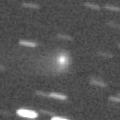
Now it is 15.3 mag (Nov. 17, Alfons Diepvens). It stays 15 mag for a while. In the Northern Hemisphere, it will be unobservable temporarily in January. In the Southern Hemisphere, it is not observable now, but it will appear in February. Date(TT) R.A. (2000) Decl. Delta r Elong. m1 Best Time(A, h) Dec. 6 19 14.38 0 10.3 4.431 3.755 41 15.3 18:18 ( 73, 23) Dec. 13 19 15.81 -0 29.5 4.487 3.736 36 15.3 18:19 ( 77, 18) |
C/2022 E2 ( ATLAS )
|
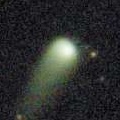
It was observed at 12-13 mag for a long time in 2024. Now it is 15.2 mag (Nov. 22, Hiroshi Abe). Fading slowly. In the Northern Hemisphere, it will be getting lower gradually. But it will be getting higher again after March. In the Southern Hemisphere, it will be unobservable soon. Date(TT) R.A. (2000) Decl. Delta r Elong. m1 Best Time(A, h) Dec. 6 22 27.14 36 24.6 5.091 5.332 98 15.8 18:18 (102, 79) Dec. 13 22 27.06 35 1.4 5.231 5.373 92 15.9 18:19 ( 96, 73) |
C/2024 R4 ( PanSTARRS )
|
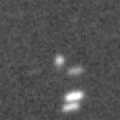
Brightening rapidly. It is expected to brighten up to 12 mag from 2027 to 2028. Now it is 16.0 mag (Nov. 17, Alfons Diepvens). It stays 16 mag for a while. In the Northern Hemisphere, it will be getting lower gradually. But it will be getting higher again after February. In the Southern Hemisphere, it will be unobservable soon. Date(TT) R.A. (2000) Decl. Delta r Elong. m1 Best Time(A, h) Dec. 6 21 28.64 21 2.3 7.051 6.961 80 16.0 18:18 ( 67, 62) Dec. 13 21 29.36 20 58.0 7.111 6.921 74 16.0 18:19 ( 75, 57) |
C/2025 Q3 ( ATLAS )
|
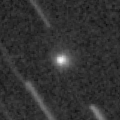
Now it is 15.7 mag (Nov. 30, Ken-ichi Kadota). It stays 17 mag for a while. In the Northern Hemisphere, it will be getting lower gradually after this, and it will be unobservable in March. In the Southern Hemisphere, it stays observable in good condition. Date(TT) R.A. (2000) Decl. Delta r Elong. m1 Best Time(A, h) Dec. 6 2 34.63 8 54.3 1.443 2.319 144 16.0 21:32 ( 0, 64) Dec. 13 2 23.97 3 59.4 1.496 2.287 133 16.0 20:54 ( 0, 59) |
C/2022 R6 ( PanSTARRS )

|
Now it is 16.2 mag (Nov. 30, ATLAS-MLO, Mauna Loa). It stays 16 mag for a while. It stays observable in good condition. Date(TT) R.A. (2000) Decl. Delta r Elong. m1 Best Time(A, h) Dec. 6 8 58.47 -12 5.1 6.200 6.601 109 16.2 4:00 ( 0, 43) Dec. 13 8 57.82 -11 59.4 6.112 6.606 116 16.1 3:32 ( 0, 43) |
C/2023 C2 ( ATLAS )

|
It brightened up to 12.7 mag in 2024 summer (Aug. 7, 2024, Thomas Lehmann). Now it is 15.8 mag (Nov. 22, Alfons Diepvens). Fading slowly. In the Northern Hemisphere, it stays observable in good condition. In the Southern Hemisphere, it will never be observable after this. Date(TT) R.A. (2000) Decl. Delta r Elong. m1 Best Time(A, h) Dec. 6 22 29.71 50 24.1 4.274 4.614 104 16.3 18:18 (154, 72) Dec. 13 22 35.00 49 45.8 4.387 4.669 100 16.4 18:19 (144, 70) |
261P/Larson
|
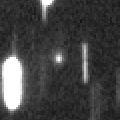
Now it is 16.1 mag (Dec. 1, ATLAS-MLO, Mauna Loa). Fading slowly. It will be unobservable in February in the Southern Hemisphere, or in March in the Northern Hemisphere. Date(TT) R.A. (2000) Decl. Delta r Elong. m1 Best Time(A, h) Dec. 6 21 32.52 -9 27.8 2.159 2.021 68 16.4 18:18 ( 34, 39) Dec. 13 21 46.24 -8 18.2 2.222 2.017 65 16.4 18:19 ( 39, 38) |
40P/Vaisala 1
|
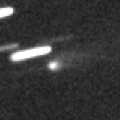
Now it is 15.8 mag (Nov. 28, Francois Kugel). It stays 17 mag for a while. In the Southern Hemisphere, it is not observable now, but it will be observable soon. Date(TT) R.A. (2000) Decl. Delta r Elong. m1 Best Time(A, h) Dec. 6 14 15.20 -5 17.9 2.466 1.840 41 16.4 5:23 (294, 22) Dec. 13 14 32.77 -6 24.7 2.435 1.851 43 16.4 5:28 (298, 24) |
493P/2024 Q2 ( LONEOS )

|
Now it is 16.5 mag (Nov. 26, Alfons Diepvens). It stays 17 mag for a while. In the Northern Hemisphere, it stays observable in good condition. It stays extremely low in the Southern Hemisphere. Date(TT) R.A. (2000) Decl. Delta r Elong. m1 Best Time(A, h) Dec. 6 4 50.22 53 47.2 2.955 3.831 148 16.5 23:49 (180, 71) Dec. 13 4 43.84 53 47.4 2.954 3.828 148 16.5 23:15 (180, 71) |
C/2024 A1 ( ATLAS )

|
Now it is 16.4 mag (Dec. 2, ATLAS-MLO, Mauna Loa). Fading slowly. In the Northern Hemisphere, it stays observable in good condition. In the Southern Hemisphere, it will be unobservable soon. Date(TT) R.A. (2000) Decl. Delta r Elong. m1 Best Time(A, h) Dec. 6 8 49.21 47 35.3 3.502 4.164 126 16.5 3:51 (180, 78) Dec. 13 8 43.82 49 55.6 3.459 4.186 132 16.5 3:19 (180, 75) |
145P/Shoemaker-Levy 5
|
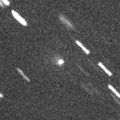
Now it is 16.5 mag (Dec. 2, ATLAS Chile). It stays 17 mag for a while. In the Northern Hemisphere, it stays observable in good condition. In the Southern Hemisphere, it will be getting lower gradually after this, and it will be unobservable in March. Date(TT) R.A. (2000) Decl. Delta r Elong. m1 Best Time(A, h) Dec. 6 22 55.60 -10 33.9 1.741 1.960 87 16.6 18:18 ( 8, 44) Dec. 13 23 5.64 -8 42.0 1.796 1.945 83 16.5 18:19 ( 15, 45) |
C/2025 J1 ( Borisov )
|
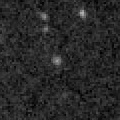
Now it is 16.3 mag (Nov. 28, ATLAS-MLO, Mauna Loa). It stays 16 mag for a while. In the Northern Hemisphere, it stays observable in good condition. In the Southern Hemisphere, it is not observable now. Date(TT) R.A. (2000) Decl. Delta r Elong. m1 Best Time(A, h) Dec. 6 10 37.23 76 51.8 3.476 3.959 112 16.7 5:23 (181, 48) Dec. 13 10 8.62 78 10.3 3.397 3.933 116 16.6 4:45 (180, 47) |
164P/Christensen

|
Now it is 17.0 mag (Dec. 1, Alfons Diepvens). It stays 17 mag for a while. In the Northern Hemisphere, it stays observable in good condition. It locates somewhat low in the Southern Hemisphere. Date(TT) R.A. (2000) Decl. Delta r Elong. m1 Best Time(A, h) Dec. 6 11 10.05 20 14.7 2.158 2.420 93 16.7 5:23 (322, 72) Dec. 13 11 16.15 20 40.7 2.109 2.461 98 16.6 5:28 (340, 75) |
C/2023 H5 ( Lemmon )

|
Now it is 16.8 mag (Nov. 22, Thomas Lehmann). It stays 17 mag for a while. It locates somewhat low in the Northern Hemisphere. But it will become high in winter. In the Southern Hemisphere, it will never be observable after this. Date(TT) R.A. (2000) Decl. Delta r Elong. m1 Best Time(A, h) Dec. 6 17 3.12 63 9.2 4.474 4.507 85 16.6 18:18 (149, 29) Dec. 13 17 25.63 62 59.0 4.483 4.524 86 16.7 18:19 (149, 28) |
47P/Ashbrook-Jackson

|
Now it is 16.2 mag (Nov. 20, Thomas Lehmann). Fading slowly. It will be getting lower gradually after this, and it will be unobservable in February in the Southern Hemisphere, or in March in the Northern Hemisphere. Date(TT) R.A. (2000) Decl. Delta r Elong. m1 Best Time(A, h) Dec. 6 22 56.43 -4 52.8 2.643 2.817 89 16.6 18:18 ( 8, 50) Dec. 13 23 2.49 -3 54.1 2.740 2.820 84 16.7 18:19 ( 18, 50) |
65P/Gunn
|
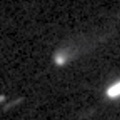
Now it is 16.9 mag (Nov. 20, Thomas Lehmann). It stays 17 mag for a while. It will be unobservable in January. But it will be observable again in March in the Southern Hemisphere. Date(TT) R.A. (2000) Decl. Delta r Elong. m1 Best Time(A, h) Dec. 6 20 10.88 -27 25.1 3.654 3.048 45 16.7 18:18 ( 42, 14) Dec. 13 20 22.05 -26 46.8 3.729 3.057 41 16.7 18:19 ( 45, 12) |
43P/Wolf-Harrington

|
Now it is 16.7 mag (Nov. 22, Thomas Lehmann). It stays 17 mag for a while. It stays observable in good condition. Date(TT) R.A. (2000) Decl. Delta r Elong. m1 Best Time(A, h) Dec. 6 10 56.33 -3 45.7 2.457 2.598 86 16.7 5:23 (347, 50) Dec. 13 11 2.12 -4 49.4 2.385 2.616 92 16.7 5:28 (357, 50) |
C/2023 F3 ( ATLAS )

|
Now it is 16.8 mag (Nov. 23, W. Hasubick). It stays 17 mag for a while. It stays observable in good condition. Date(TT) R.A. (2000) Decl. Delta r Elong. m1 Best Time(A, h) Dec. 6 10 58.16 -24 35.1 5.782 5.677 79 16.9 5:23 (351, 30) Dec. 13 10 55.30 -24 44.8 5.686 5.698 85 16.8 5:28 ( 0, 30) |
C/2023 X2 ( Lemmon )

|
Now it is 17.0 mag (Nov. 29, Ken-ichi Kadota). It stays 17 mag for a while. In the Northern Hemisphere, it stays observable in good condition. In the Southern Hemisphere, it will never be observable after this. Date(TT) R.A. (2000) Decl. Delta r Elong. m1 Best Time(A, h) Dec. 6 14 54.84 85 51.2 4.688 5.092 108 16.8 5:23 (185, 37) Dec. 13 16 15.33 85 34.0 4.686 5.090 108 16.8 5:28 (185, 36) |
195P/Hill

|
Now it is 16.9 mag (Nov. 22, Kunihiro Shima). It stays 17 mag for a while. It locates somewhat low in the Northern Hemisphere. In the Southern Hemisphere, it stays observable in good condition. Date(TT) R.A. (2000) Decl. Delta r Elong. m1 Best Time(A, h) Dec. 6 9 56.62 -27 45.5 4.356 4.475 90 16.9 4:58 ( 0, 27) Dec. 13 9 57.75 -28 52.3 4.278 4.479 95 16.9 4:31 ( 0, 26) |
C/2023 RS61 ( PanSTARRS )
|
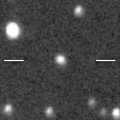
Although it is around 20 mag usually, now it is bright in outburst. Now it is 17.2 mag (Nov. 11, ATLAS-HKO, Haleakala). It stays 17 mag for a while. In the Northern Hemisphere, it stays observable in good condition. In the Southern Hemisphere, it will be unobservable in March. Date(TT) R.A. (2000) Decl. Delta r Elong. m1 Best Time(A, h) Dec. 6 2 49.02 37 48.8 7.945 8.812 149 17.0 21:48 (180, 87) Dec. 13 2 46.90 37 34.9 7.985 8.803 144 17.0 21:18 (180, 87) |
302P/Lemmon-PanSTARRS

|
It brightened very rapidly, and it became brighter than expected. Now it is 16.8 mag (Nov. 23, Thomas Lehmann). Fading slowly. It will be fainter than 18 mag in February. In the Northern Hemisphere, it stays observable in good condition. In the Southern Hemisphere, it will be getting lower gradually. Date(TT) R.A. (2000) Decl. Delta r Elong. m1 Best Time(A, h) Dec. 6 0 19.45 -5 12.2 3.062 3.502 108 17.0 19:19 ( 0, 50) Dec. 13 0 21.70 -4 45.8 3.171 3.512 102 17.1 18:53 ( 0, 50) |
C/2025 R3 ( PanSTARRS )
|
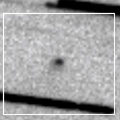
It is expected to brighten up to 7 mag in 2026 April. Now it is 17.2 mag (Nov. 1, Ken-ichi Kadota). It will brighten rapidly after this. It will be unobservable soon in the Southern Hemisphere, or in February in the Northern Hemisphere. But it will be observable again in March in the Northern Hemisphere. At the high light, it is observable in the low sky before the perihelion passage in the Northern Hemisphere, or after the perihelion in the Southern Hemisphere. Date(TT) R.A. (2000) Decl. Delta r Elong. m1 Best Time(A, h) Dec. 6 22 29.14 25 56.5 2.198 2.491 95 17.2 18:18 ( 53, 76) Dec. 13 22 22.83 24 13.6 2.229 2.394 87 17.0 18:19 ( 66, 69) |
48P/Johnson
|
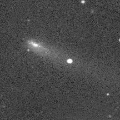
Now it is 16.2 mag (Nov. 19, Andrew Pearce). Fading gradually. It will be fainter than 18 mag in January. It stays observable in good condition. Date(TT) R.A. (2000) Decl. Delta r Elong. m1 Best Time(A, h) Dec. 6 3 16.35 3 5.6 1.943 2.841 150 17.1 22:15 ( 0, 58) Dec. 13 3 12.28 3 30.7 2.021 2.872 143 17.3 21:43 ( 0, 59) |
C/2019 E3 ( ATLAS )
|
Very far object. Now it is 16.6 mag (Oct. 19, ATLAS Chile). It stays 17 mag for a while. In the Northern Hemisphere, it will be unobservable in January. In the Southern Hemisphere, it stays observable in good condition. Date(TT) R.A. (2000) Decl. Delta r Elong. m1 Best Time(A, h) Dec. 6 0 8.00 -53 39.5 11.139 11.060 82 17.2 19:07 ( 0, 2) Dec. 13 0 6.45 -52 57.9 11.231 11.074 78 17.2 18:38 ( 0, 2) |
C/2024 X2 ( ATLAS )

|
Now it is 17.8 mag (Nov. 28, W. Hasubick). It stays 18 mag for a while. It stays observable in good condition. Date(TT) R.A. (2000) Decl. Delta r Elong. m1 Best Time(A, h) Dec. 6 9 15.51 -2 7.8 3.439 3.899 110 17.4 4:17 ( 0, 53) Dec. 13 9 10.60 -0 56.9 3.345 3.919 119 17.4 3:45 ( 0, 54) |
93P/Lovas 1
|
Now it is 18.2 mag (Nov. 21, Ken-ichi Kadota). Brightening slowly. It will be unobservable in January in the Southern Hemisphere, or in March in the Northern Hemisphere. It will brighten up to 15.5 mag in spring. But it is not observable around the perihelion passage. Date(TT) R.A. (2000) Decl. Delta r Elong. m1 Best Time(A, h) Dec. 6 21 33.25 -13 17.8 2.417 2.235 67 17.5 18:18 ( 32, 36) Dec. 13 21 43.21 -12 2.7 2.455 2.194 63 17.4 18:19 ( 38, 35) |
123P/West-Hartley
|
|
It will brighten up to 15 mag from autumn to winter in 2026. Now it is 17.8 mag (Nov. 28, ATLAS-HKO, Haleakala). It stays 17 mag for a while. In the Northern Hemisphere, it stays observable in good condition. It locates somewhat low in the Southern Hemisphere. Date(TT) R.A. (2000) Decl. Delta r Elong. m1 Best Time(A, h) Dec. 6 3 42.28 27 5.6 2.041 3.001 164 17.5 22:40 ( 0, 82) Dec. 13 3 35.68 27 10.2 2.044 2.971 156 17.4 22:06 ( 0, 82) |
C/2017 K2 ( PanSTARRS )
|
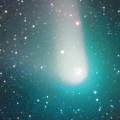
It brightened up to 8 mag from 2022 summer to 2023 spring. Now it is 17.0 mag (Dec. 1, Alfons Diepvens). It stays 18 mag for a while. In the Northern Hemisphere, it stays observable in good condition. It locates somewhat low in the Southern Hemisphere. Date(TT) R.A. (2000) Decl. Delta r Elong. m1 Best Time(A, h) Dec. 6 6 0.38 30 21.7 9.170 10.113 162 17.4 1:03 ( 0, 85) Dec. 13 5 56.92 30 31.0 9.194 10.162 168 17.5 0:32 ( 0, 86) |
217P/LINEAR
|
It brightened up to 12.1 mag in early summer (June 10, Taras Prystavski). Now it is 17.1 mag (Nov. 25, ATLAS-MLO, Mauna Loa). Fading gradually. It will be fainter than 18 mag in January. It stays observable in good condition. Date(TT) R.A. (2000) Decl. Delta r Elong. m1 Best Time(A, h) Dec. 6 9 18.36 13 8.3 1.914 2.505 115 17.5 4:20 ( 0, 68) Dec. 13 9 16.78 13 38.9 1.883 2.561 123 17.6 3:51 ( 0, 69) |
60P/Tsuchinshan 2
|
|
The condition of this apparition is bad. It must have brightened up to 16 mag in summer, but it was not observable. Fading gradually. It will be fainter than 18 mag soon. It locates somewhat low in the Northern Hemisphere. In the Southern Hemisphere, it will be getting higher gradually. Date(TT) R.A. (2000) Decl. Delta r Elong. m1 Best Time(A, h) Dec. 6 13 49.91 -14 11.2 2.700 2.095 43 17.5 5:23 (306, 20) Dec. 13 14 2.97 -15 23.8 2.679 2.132 46 17.7 5:28 (310, 23) |
(306173) 2010 NK83
|
|
Peculiar asteroid moving along a cometary orbit. Now it is 18.1 mag (Oct. 5, ATLAS-HKO, Haleakala). Fading slowly. It will be fainter than 18 mag in February. In the Northern Hemisphere, it stays observable in good condition. Date(TT) R.A. (2000) Decl. Delta r Elong. m1 Best Time(A, h) Dec. 6 8 7.86 20 15.6 1.724 2.511 133 17.7 3:10 ( 0, 75) Dec. 13 8 7.80 20 54.8 1.679 2.523 141 17.5 2:42 ( 0, 76) |
C/2019 U5 ( PanSTARRS )
|
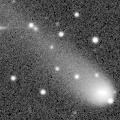
Now it is 17.2 mag (Nov. 15, Andrew Pearce). It stays 18 mag for a while. It stays extremely low in the Northern Hemisphere. In the Southern Hemisphere, it stays observable in good condition. Date(TT) R.A. (2000) Decl. Delta r Elong. m1 Best Time(A, h) Dec. 6 5 9.29 -47 56.5 8.309 8.687 109 17.6 0:11 ( 0, 7) Dec. 13 5 2.80 -47 53.0 8.363 8.731 108 17.6 23:32 ( 0, 7) |
C/2025 R1 ( ATLAS )
|
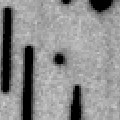
Now it is 17.3 mag (Nov. 22, Francois Kugel). Fading slowly. It will be fainter than 18 mag soon. It locates somewhat low in the Northern Hemisphere. In the Southern Hemisphere, it will never be observable after this. Date(TT) R.A. (2000) Decl. Delta r Elong. m1 Best Time(A, h) Dec. 6 18 53.67 35 11.5 2.190 1.981 64 17.7 18:18 (111, 37) Dec. 13 18 57.72 32 23.6 2.286 1.990 60 17.8 18:19 (110, 31) |
276P/Vorobjov

|
Now it is 17.7 mag (Nov. 25, ATLAS-MLO, Mauna Loa). It stays 18 mag for a while. It stays observable in good condition. Date(TT) R.A. (2000) Decl. Delta r Elong. m1 Best Time(A, h) Dec. 6 7 4.37 5 16.5 3.381 4.212 143 17.7 2:06 ( 0, 60) Dec. 13 7 1.13 5 0.8 3.344 4.223 149 17.7 1:36 ( 0, 60) |
C/2024 G2 ( ATLAS )

|
Now it is 17.8 mag (Nov. 14, W. Hasubick). It stays 18 mag for a while. In the Northern Hemisphere, it stays observable in good condition. In the Southern Hemisphere, it will be getting higher gradually. Date(TT) R.A. (2000) Decl. Delta r Elong. m1 Best Time(A, h) Dec. 6 12 11.83 -11 39.2 5.818 5.503 66 17.7 5:23 (326, 36) Dec. 13 12 12.47 -11 17.1 5.710 5.516 73 17.7 5:28 (335, 40) |
C/2020 K1 ( PanSTARRS )
|
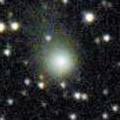
It brightened up to 12.1 mag in 2023 spring (May 20, 2023, Jose Guilherme de S. Aguiar). It stays 18 mag for a while. It stays observable in good condition. Date(TT) R.A. (2000) Decl. Delta r Elong. m1 Best Time(A, h) Dec. 6 6 23.20 -20 40.8 7.864 8.546 131 17.8 1:25 ( 0, 34) Dec. 13 6 19.55 -20 33.6 7.879 8.592 133 17.8 0:54 ( 0, 34) |
C/2023 U1 ( Fuls )
|
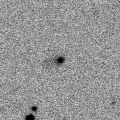
It continues brightening even after the perihelion passage. Now it is 17.5 mag (Nov. 19, ATLAS South Africa). It stays 18 mag for a while. In the Northern Hemisphere, it will never be observable after this. In the Southern Hemisphere, it will be getting lower gradually. Date(TT) R.A. (2000) Decl. Delta r Elong. m1 Best Time(A, h) Dec. 6 23 19.48 -61 50.9 6.102 5.902 73 17.8 18:19 ( 0, -7) Dec. 13 23 15.54 -60 34.4 6.204 5.930 69 17.9 18:19 ( 4, -6) |
(468861) 2013 LU28
|
Peculiar asteroid moving along a cometary orbit. It brightened up to 17 mag from 2024 to 2025. Now it is 17.8 mag (Oct. 5, ATLAS-HKO, Haleakala). It stays 18 mag for a while. It stays observable in good condition. Date(TT) R.A. (2000) Decl. Delta r Elong. m1 Best Time(A, h) Dec. 6 6 36.43 22 51.0 8.345 9.249 155 18.0 1:39 ( 0, 78) Dec. 13 6 31.99 22 36.4 8.314 9.262 163 17.9 1:07 ( 0, 78) |
C/2025 V1 ( Borisov )
|
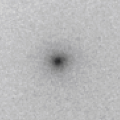
It brightened up to 10.4 mag in early November (Nov. 4, Michael Jager and Gerald Rhemann). However, it faded out very rapidly afer that. Fading rapidly. It stays extremely low in the Northern Hemisphere. In the Southern Hemisphere, it is not observable now. Date(TT) R.A. (2000) Decl. Delta r Elong. m1 Best Time(A, h) Dec. 6 17 54.37 1 20.2 1.334 0.664 28 18.1 18:18 ( 86, 8) Dec. 13 18 14.98 -1 30.5 1.552 0.785 25 19.6 18:19 ( 85, 5) |
C/2013 C2 ( Tenagra )
|
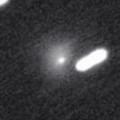
It brightened in major outburst of 5 mag. Now it is 17.8 mag (Oct. 14, E. Cortes, B. Lutkenhoner). It stays 19 mag for a while. It locates somewhat low in the Northern Hemisphere. It stays extremely low in the Southern Hemisphere. Date(TT) R.A. (2000) Decl. Delta r Elong. m1 Best Time(A, h) Dec. 6 19 53.13 -3 35.2 15.723 15.085 48 18.3 18:18 ( 62, 28) Dec. 13 19 54.88 -3 33.7 15.814 15.099 42 18.4 18:19 ( 67, 23) |
489P/Denning
|
|
It had been lost for 113 years. It will pass the perihelion on Dec. 4. It brightened up to 18 mag in outburst in 2007. Brightening slowly. In the Northern Hemisphere, it stays observable in good condition. In the Southern Hemisphere, it will be getting higher gradually. Date(TT) R.A. (2000) Decl. Delta r Elong. m1 Best Time(A, h) Dec. 6 11 31.29 7 55.5 1.328 1.561 83 22.1 5:23 (326, 59) Dec. 13 11 48.22 6 6.4 1.286 1.564 86 22.1 5:28 (334, 59) |